Closing validation and boarding for community banks — Jack Henry first
Prove the loan is right. Then board it.
Bookend reads the executed closing package, reconciles every variable term against the credit approval, verifies execution, and stages boarding and funding for your own maker-checker approval — inside your network, with an examiner-ready evidence packet for every loan.
On-prem
Docker containers inside your network. No cloud tenant, no SaaS.
No data egress
Loan documents and extracted terms never leave the institution.
Examiner-ready
A hash-chained evidence packet for every loan, exportable as PDF and JSON.
Human approves
Nothing is boarded and no wire is sent without your maker-checker sign-off.
The problem
The 5% of every package that isn’t boilerplate is where boarding errors live.
Rates, dates, amounts, parties. A closing specialist compares them across seven or eight documents and the approval, keys them into the core, and prepares the wire — by hand, on every loan. Bookend does the comparing and the keying, and leaves the judgement and the approvals with your people.
Stare-and-compare, retired
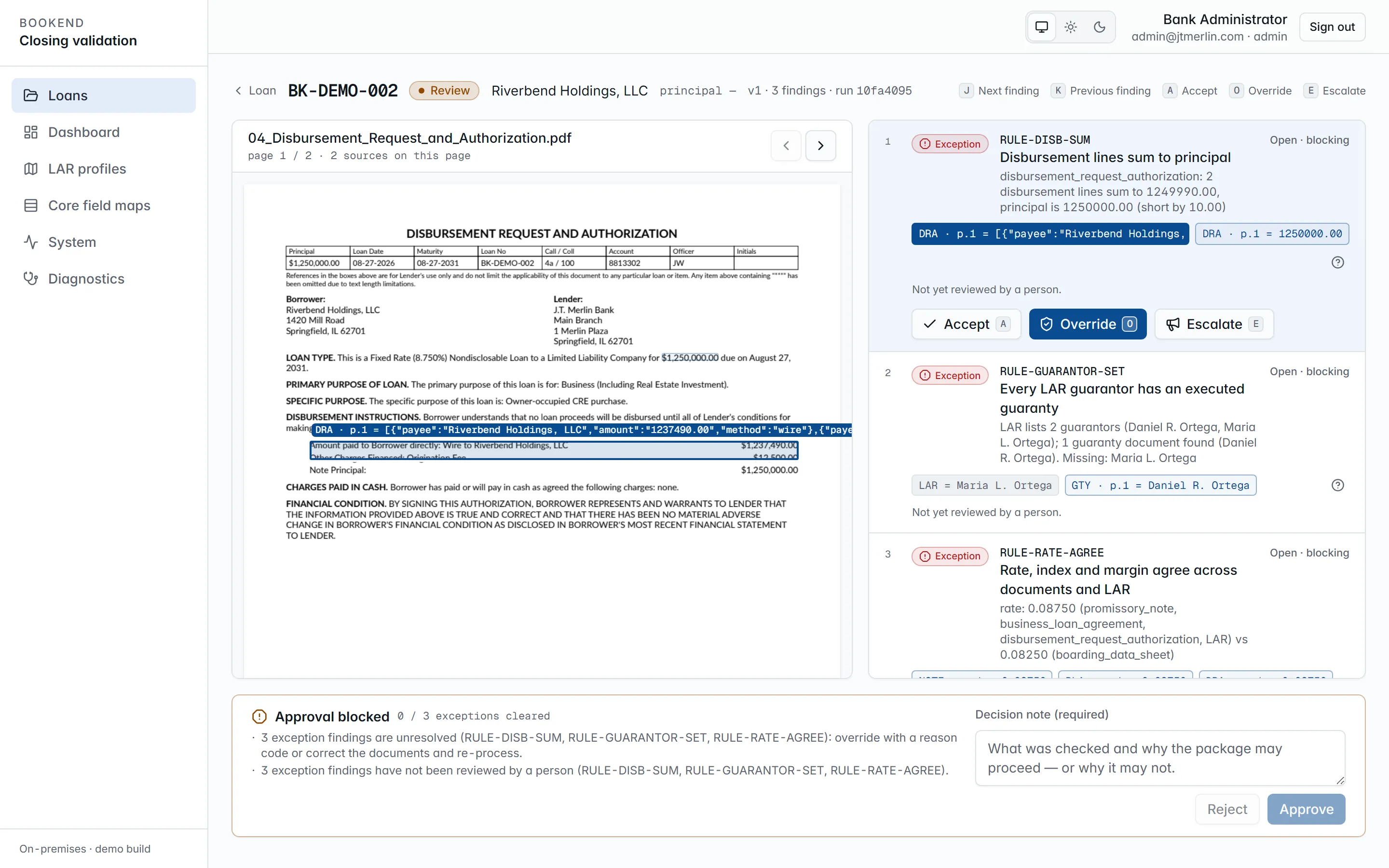
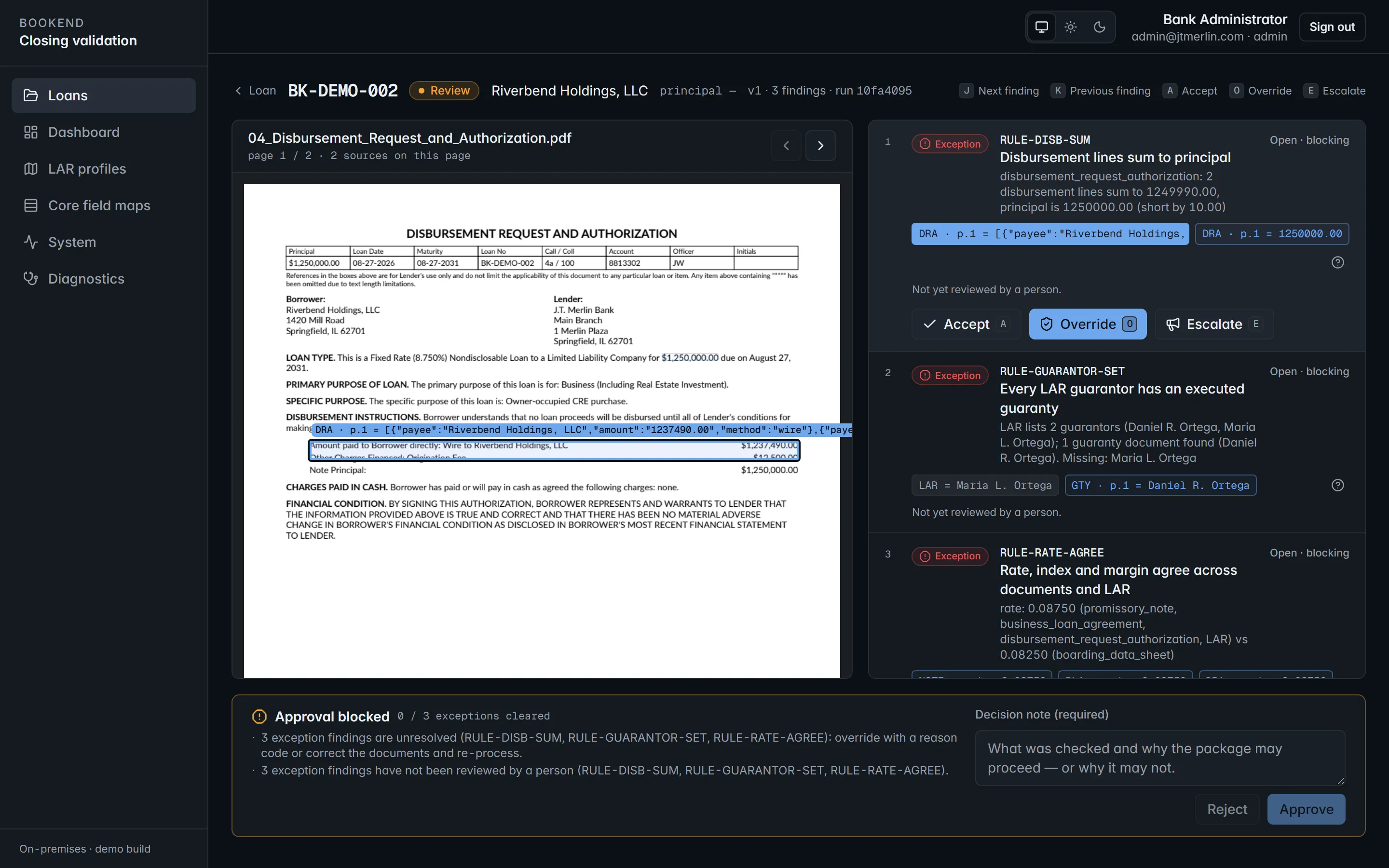
Cross-document disagreement — the note says one rate, the boarding sheet another; a guarantor on the approval without a guaranty; disbursements that don’t sum to principal — surfaces as a finding with every source attached.
No re-keying
The boarding record is built from the executed documents, mapped to your core fields, and shown with provenance before anyone approves it.
Execution gaps caught before funding
Unsigned pages, missing initials and empty notary blocks are exceptions on the review screen, not discoveries after the wire.
How it works
Validate → verify → board → fund → evidence
- 1
Validate
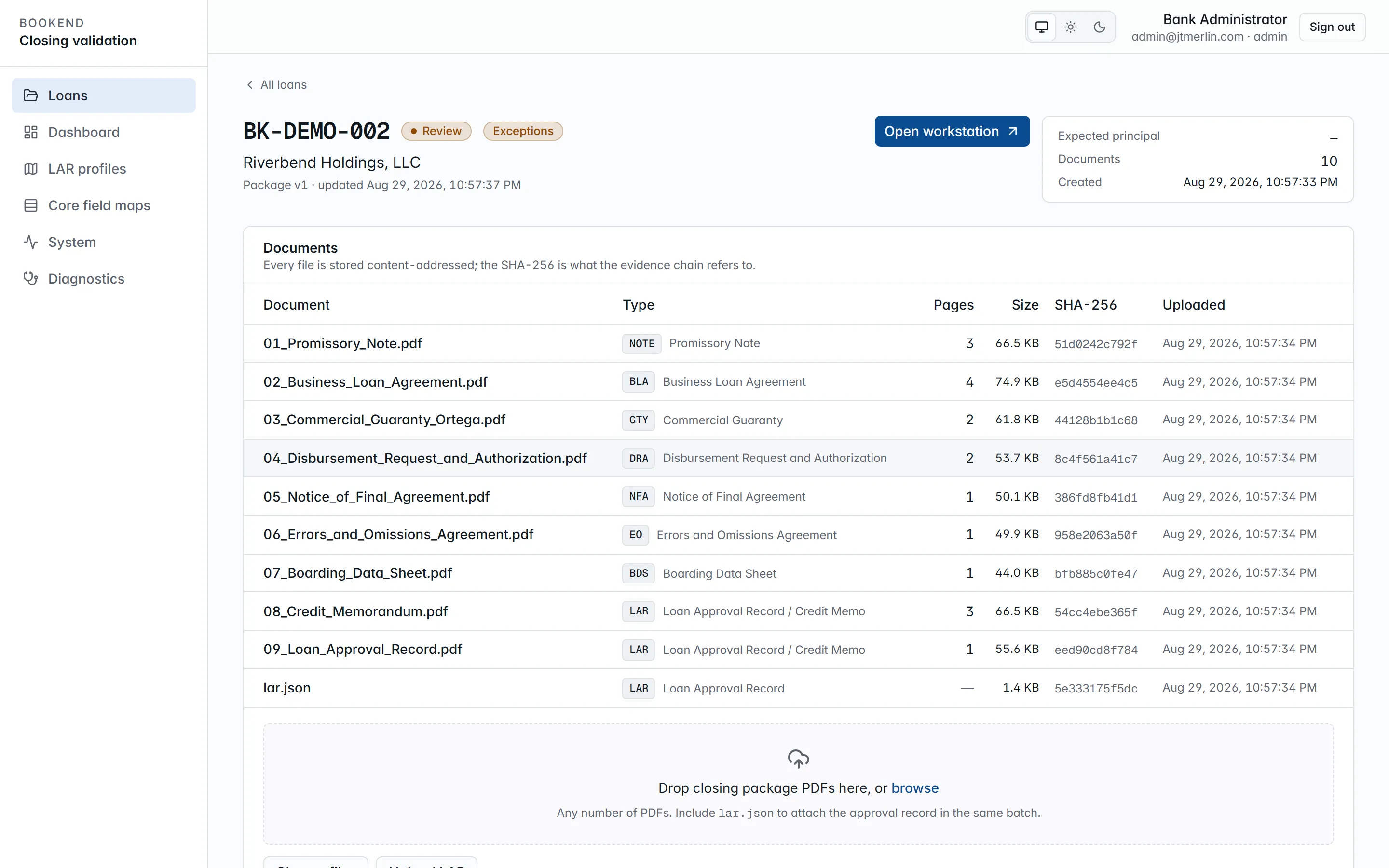
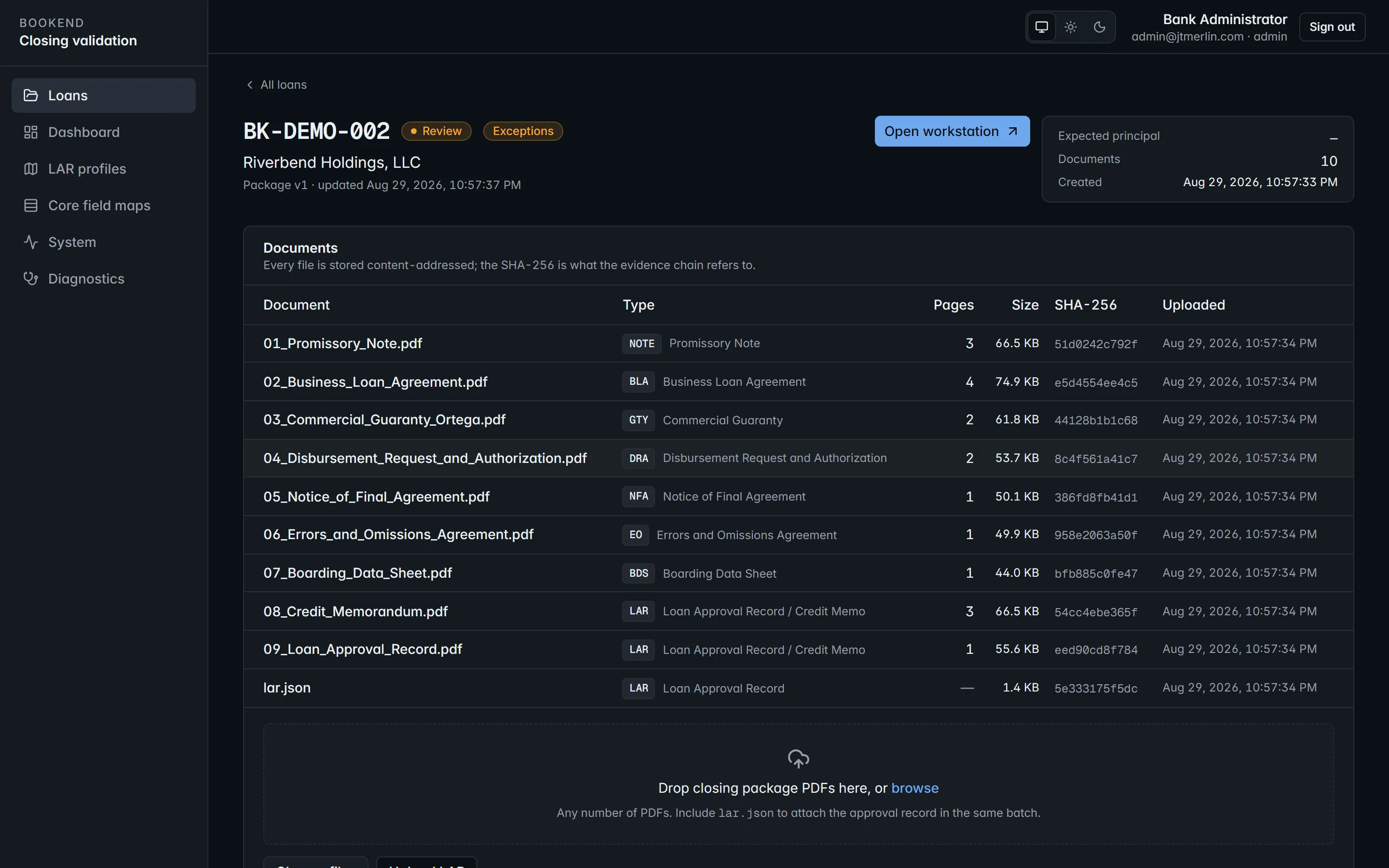
The package and the approval come in; every term is extracted with its page and position.
- 2
Verify
Rules reconcile the terms and check execution. A specialist accepts, overrides or escalates each exception.
- 3
Board
The staged core record is approved by a checker and committed once, with the provider’s answer recorded.
- 4
Fund
The wire request is staged from the disbursement authorization and approved by a second person. Your wire room sends it.
- 5
Evidence
The loan is sealed. The packet proves what was checked, by whom, against what, and that nothing changed since.
Operating principle
The model finds. The rules judge. A human approves.
Extraction and classification use a model that runs inside the container. Whether terms agree is decided by deterministic, versioned rules that can be explained to an examiner. Every loan passes a review screen where a specialist accepts, overrides or escalates before anything reaches the core.
Capabilities
Six blocks, one pipeline
Intake
Upload, watch folder, LOS integration or API. Native PDFs and scanned executed copies, plus the credit approval record (LAR).
Extraction with provenance
Every document classified, every variable term located with page and position. Each value keeps a link back to the exact spot it came from.
Reconciliation
Deterministic, versioned rules compare note ↔ loan agreement ↔ guaranties ↔ disbursement ↔ boarding sheet ↔ approval. Agreement or exception, per term, explained line by line.
Execution verification
Signatures, initials, dates and notary blocks checked per document against the bank’s execution templates. Missing marks become exceptions with the zone highlighted.
Boarding
A staged boarding record mapped to your core fields, approved by a second person, committed through jXchange or a file export. Never twice.
Evidence
An append-only, hash-chained packet per loan — extractions, comparisons, overrides, approvals — exportable as PDF and JSON for auditors and examiners.
Delivery
Delivered with implementation, not downloaded
Every Bookend installation is a professional-services engagement: discovery of your closing workflow, install inside your network, your approval record and core fields mapped, a parallel run on twenty to thirty of your own historical closings with an accuracy report, training, and go-live with human approval on every loan. Six to ten weeks, typically — and nothing in it forks the software for your bank.
Proven on your closings first
The parallel run is the acceptance test: your packages, your approval record, your findings, compared with what your specialists found.
The engagement, stage by stageJack Henry first
SilverLake, CIF 20/20 and Core Director through jXchange under the Vendor Integration Program. File export for any core today; more adapters in the works.
For Jack Henry banksSupported after go-live
Signed releases you pull on your own schedule, runbooks that ship with the product, Standard or Premium support with a named engineer.
How it is priced
Start with a Closing Workflow Review
Forty-five minutes with your head of loan operations: we map approval → documents → execution → boarding → funding, count the touches, and pull three recent boarding exceptions. You get a one-page Closing Error and Capacity Map — whether or not you go further.